As an Amazon Associate I earn from qualifying purchases. Purchases through our links may earn us a commission at no extra cost to you.
For a security camera that repeatedly records to microSD, shortlist an endurance-rated card that the exact camera supports. Choose its capacity separately, according to how much footage you want to retain. A fast card is not automatically an endurance card, and a large card does not guarantee that your camera accepts it.
Our concrete option is the SanDisk High Endurance 128GB, model SDSQQNR-128G-GN6IA. The product and capacity match an entry in TP-Link’s tested-card guidance. That makes it a reasonable candidate for a compatible camera—not a guarantee for every Tapo, Kasa, Wyze or other model. Research checked September 17, 2026; no write-life testing is claimed.
Capacity, speed and endurance solve different problems
| Attribute | What it helps answer | What it does not prove |
|---|---|---|
| Capacity, such as 128GB | How much data can fit before old footage is overwritten? | How long the card will survive repeated writes. |
| Speed class, such as U3 or V30 | Can the card sustain an appropriate recording data rate? | That it is designed for years of recording loops. |
| Endurance rating | Is the product designed and rated for repeated video writing? | A guaranteed lifetime in your particular camera. |
| Camera compatibility | Will this model and firmware accept the card and capacity? | That every larger capacity in the same brand will work. |
TP-Link recommends appropriate speed classes and endurance-oriented cards for repeated recording. Its compatibility guidance lists a SanDisk High Endurance 128GB U3/V30 card among tested options. Check your camera’s current manual as well: family-wide marketing about larger capacities can differ from an older model’s own limit.
Do not substitute “same brand” for “same product.” High Endurance and Ultra are different product lines. Nor does a successful 128GB card prove that a 512GB version will work. Record the product line, capacity and exact camera before ordering.
Retention depends on how much video you write
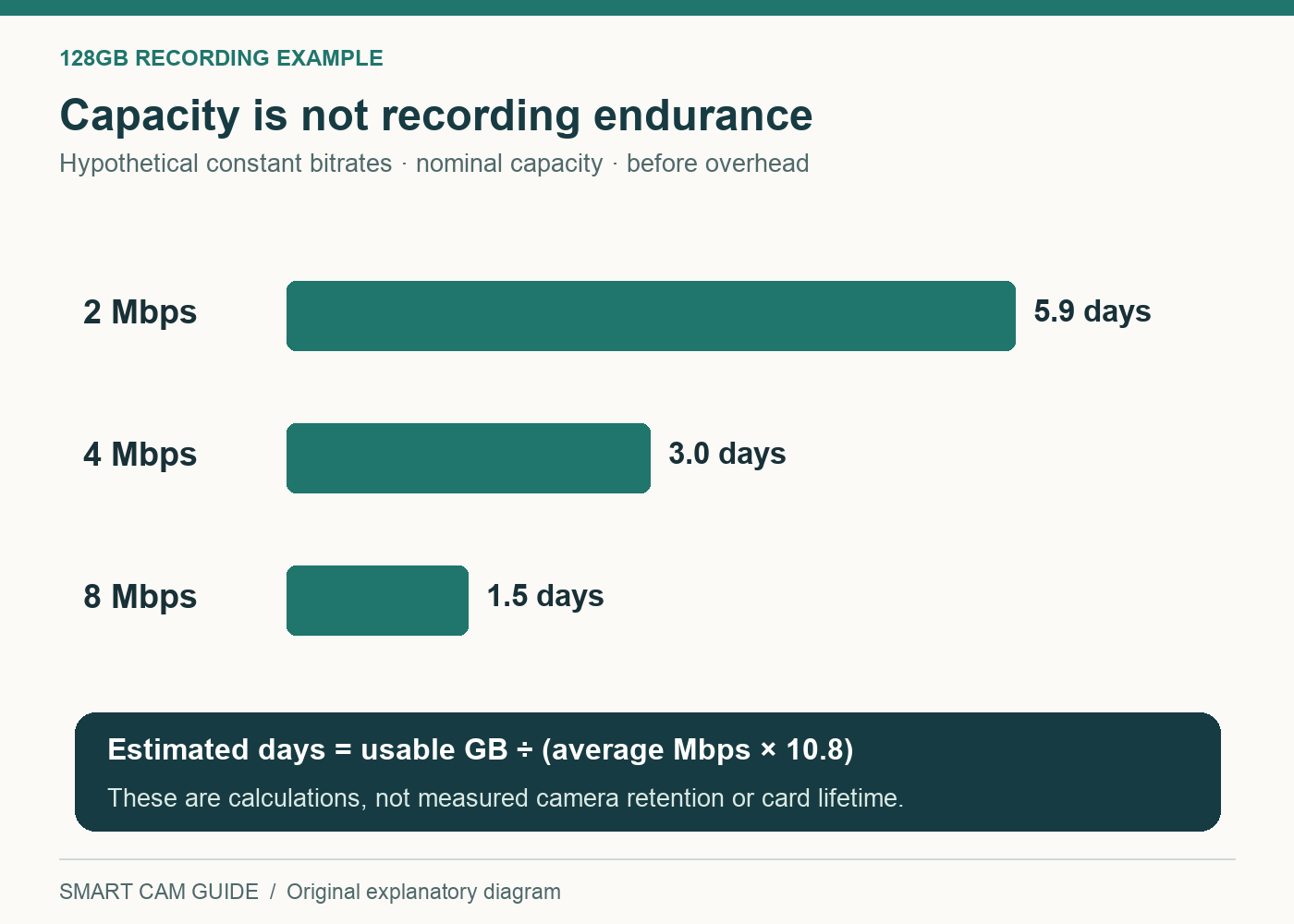
For a simple constant-bitrate estimate, one megabit per second uses approximately 10.8 decimal gigabytes per day. Divide usable capacity by daily data use to estimate retention. This ignores formatting overhead and other files, so it is an upper planning estimate—not a promise from any camera manufacturer.
Estimated days ≈ usable GB ÷ (average Mbps × 10.8). Real cameras may use variable bitrate, audio and different recording modes. Motion-only recording changes the amount written, and a busy scene can behave differently from a quiet one.
| Hypothetical average bitrate | Data per day | Nominal 128GB retention |
|---|---|---|
| 2 Mbps | 21.6GB | About 5.9 days before overhead. |
| 4 Mbps | 43.2GB | About 3.0 days before overhead. |
| 8 Mbps | 86.4GB | About 1.5 days before overhead. |
For example, seven days at a continuous 4 Mbps would require about 302.4GB before overhead. That does not mean you should automatically buy a larger card: the camera must support that capacity, and its actual average bitrate may differ. You might need a different retention goal or a separate recording destination.
“10,000 hours” does not mean 10,000 hours stored at once
SanDisk rates this 128GB High Endurance model for up to 10,000 hours of Full HD recording under its stated conditions; the manufacturer notes that 4K recording reduces that figure. This is cumulative recording endurance across repeated writes. It is not the length of a single playback timeline that fits on the card.
The distinction matters when comparing a storage claim with a household requirement. “Keep last week’s footage” is a capacity and bitrate question. “Handle repeated overwriting” is an endurance question. Neither rating means the card cannot fail, and a limited warranty does not recover a lost clip.
Why shortlist the SanDisk High Endurance 128GB?
It is a specific endurance product with published recording-life guidance and a matching 128GB entry in TP-Link’s compatibility list. During our US marketplace check, the 128GB version was available and appeared in the microSD Best Sellers category. Those are availability and market-interest signals; they are not proof of reliability or authenticity for every seller.
Choose it when the camera supports this capacity and your measured retention requirement is modest enough. Skip it when you need much longer continuous history than 128GB can provide, your manual requires another specification, or an existing recorder already provides the storage you need.
SanDisk High Endurance 128GB — SDSQQNR-128G-GN6IA
Check price on AmazonCheck the selected capacity, product line, seller and supplied packaging on the current offer. A listing may contain several sizes, and changing the variation can change both price and compatibility. Compare total delivered cost for the exact capacity rather than treating the cheapest small card as the best value.
A useful first-week acceptance check
- Confirm the camera model, firmware, supported capacity and recording mode before insertion.
- Back up any existing card contents before formatting. Formatting is destructive; use the camera’s documented procedure for a card you intend to dedicate to recording.
- Check that the camera recognizes the capacity and records an ordinary event.
- Replay the saved footage, then export one non-sensitive test clip and confirm it opens.
- After several days, inspect the oldest available recording and estimate the real retention window.
- Confirm the intended overwrite behavior when storage fills. Do not assume that every recording setting enables a continuous loop.
If errors recur, preserve any needed footage before troubleshooting or replacement. Repeated formatting without checking compatibility can mask a problem temporarily while destroying the evidence you wanted to retain. Keep important clips elsewhere; a card left in the camera can be lost with the device.
For the Kasa EC70, use our model-specific recording guide alongside the current manual. For a Tapo C120 with a separate recorder, our RTSP and NAS guide explains the additional equipment and acceptance checks. For Wyze, see the Cam v4 local-recording trade-offs.
Our buying judgment
The sensible purchase is the smallest supported endurance capacity that comfortably meets your actual history requirement, with room for uncertainty. Buy a larger supported version when the retention calculation justifies it, not because capacity is a substitute for endurance. For a compatible camera and a shorter local history, the named 128GB card is a practical starting candidate.
SanDisk High Endurance 128GB — confirm the exact capacity
Check price on AmazonSources: TP-Link microSD selection and compatibility FAQ, updated August 3, 2026; SanDisk High Endurance specifications for SDSQQNR-128G-GN6IA; selected US Amazon variant. Checked September 17, 2026. Retention figures are transparent calculations, not measured camera results. Compatibility and warranty conditions remain model-specific.
With Blink Mini 2K+, the storage media goes in a compatible Sync Module. Our Mini 2K+ local-storage guide separates Module 2 USB storage, XR microSD storage and Core’s lack of local storage.
For a two-camera household example, our Tapo C211 two-room recording guide covers separate microSD cards, power connections and playback checks for each camera. A two-pack does not turn two local cards into one shared archive.
For a cellular camera, a local memory card and a mobile data plan pay for different things. Our 4G camera service-cost worksheet separates the connection, optional cloud retention, hardware and maintenance costs.
Parking footage also needs the right power setup
For a VIOFO A229 Plus, choosing a recording card is only one part of the parked-recording purchase. Our A229 Plus and HK4 buying guide explains the supported power kit, accessory budget and cutoff limits. Check VIOFO’s card compatibility separately; the endurance-card examples on this page do not establish approval for that dash camera.
Include storage replacements in the long-term budget. Our camera ownership-cost and cellular-data workbook separates one-time purchases from services and maintenance, with editable one-year and three-year totals.