As an Amazon Associate I earn from qualifying purchases. Purchases through our links may earn us a commission at no extra cost to you.
Ring Advanced Pre-Roll adds up to six seconds of video before a motion event is triggered. Its purpose is to show some of the lead-up to that event. It does not, by itself, mean you can select any moment from an entire day of saved video.
For a buyer concerned about clips starting too late, this is a useful feature to check. It still needs to be considered alongside camera placement, motion detection and the required recording plan.
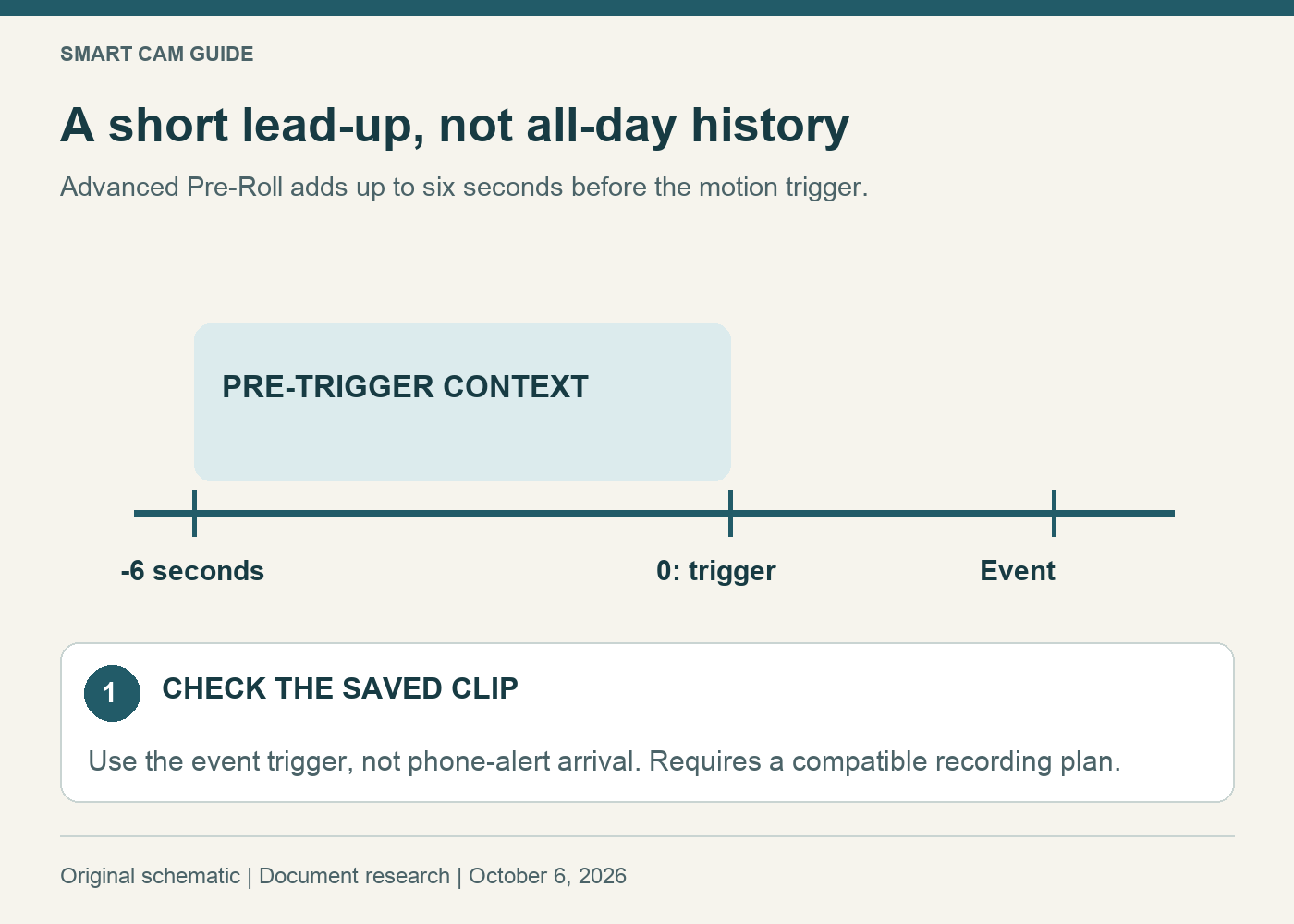
Read the timeline from the trigger, not the phone alert
Imagine that a motion trigger occurs at time zero. The illustrative six-second region immediately before zero is the context window. A person who entered the scene within that interval might appear before the action that triggered the event.
Now imagine that the action you need happened much earlier. A six-second window is not a promise to recover it. Likewise, the time your phone displays a notification is not necessarily the instant the camera’s event was triggered. Judge the saved clip’s contents, not only the arrival time of the alert.
These examples explain the timing concept; they are not measurements of Ring’s detection or notification delay.
Pre-Roll and Advanced Pre-Roll are different features
Ring’s current US guide distinguishes regular Pre-Roll, with up to four seconds on supported devices, from Advanced Pre-Roll, with up to six seconds. Advanced Pre-Roll is described as high-definition color video with sound and low-light functionality, and as always enabled on wired cameras and doorbells.
Do not follow a battery-doorbell Pre-Roll toggle instruction and assume the same control must exist on a plug-in Indoor Cam. Verify the exact product and current app guidance.
Saved context requires the recording arrangement
Ring specifies a compatible subscription for the feature. Advanced Pre-Roll appears at the beginning of a recorded event in the timeline. Ring also describes a picture-in-picture behavior for ordinary Pre-Roll when answering an alert; that is not a general promise of saved Advanced Pre-Roll without a plan.
Before purchasing, write down whether you need live viewing, saved motion events or continuous history. Those are different requirements. Our Snapshot Capture versus video guide explains why periodic stills do not answer the same question as a saved moving sequence.
What this will not fix on its own
- The camera points away from the approach: extra time does not create a view outside the frame.
- The relevant event is not saved: establish the detection and recording settings before expecting earlier context.
- The event began well before the window: assess a suitable continuous-recording arrangement if that history is essential.
- Capture was intentionally stopped: a privacy setting is a separate part of the system.
For the Indoor Cam’s physical control, review the privacy-cover and audio guide. Do not defeat a household’s privacy plan just to maximize footage.
Which Indoor Cam does the shopping link select?
The selected model is the white, one-camera Ring Indoor Cam (2nd Gen), with 1080p video, plug-in power and a manual privacy cover. Ring lists Advanced Pre-Roll among its features. The newer 2K camera is a separate selection on the shopping page.
Check Ring Indoor Cam — white, one 1080p camera
Consider it for an indoor position with suitable power and connectivity when event lead-up is useful and a compatible recording plan fits your needs. Do not buy it on the assumption that six-second context alone supplies unrestricted all-day history.
A practical check after setup
With the household’s agreement, use an ordinary non-sensitive scene. Note a simple action just before walking into the intended detection area, then review the saved event. Can you see the lead-up you actually wanted? Repeat for the normal approach direction rather than staging an unusually easy path.
If the beginning is missing, record the model, plan, relevant settings and observed clip timing before changing several controls at once. This provides a useful troubleshooting record without inventing a promised capture distance or success rate.
Research scope: Ring’s current US Pre-Roll guidance and Indoor Cam information, checked October 6, 2026. The timeline is illustrative; no camera, subscription or recording performance was tested.