By Smart Cam Guide
As an Amazon Associate I earn from qualifying purchases. Purchases through our links may earn us a commission at no extra cost to you.
Keep a rear CPL only if comparable rear clips show a useful reduction in reflection without sacrificing the low-light detail you need. A filter can reduce some reflected light while also cutting some of the incoming light. Dark rear glass adds another constraint. The front channel looking better with a filter says little about the rear channel through different glass.
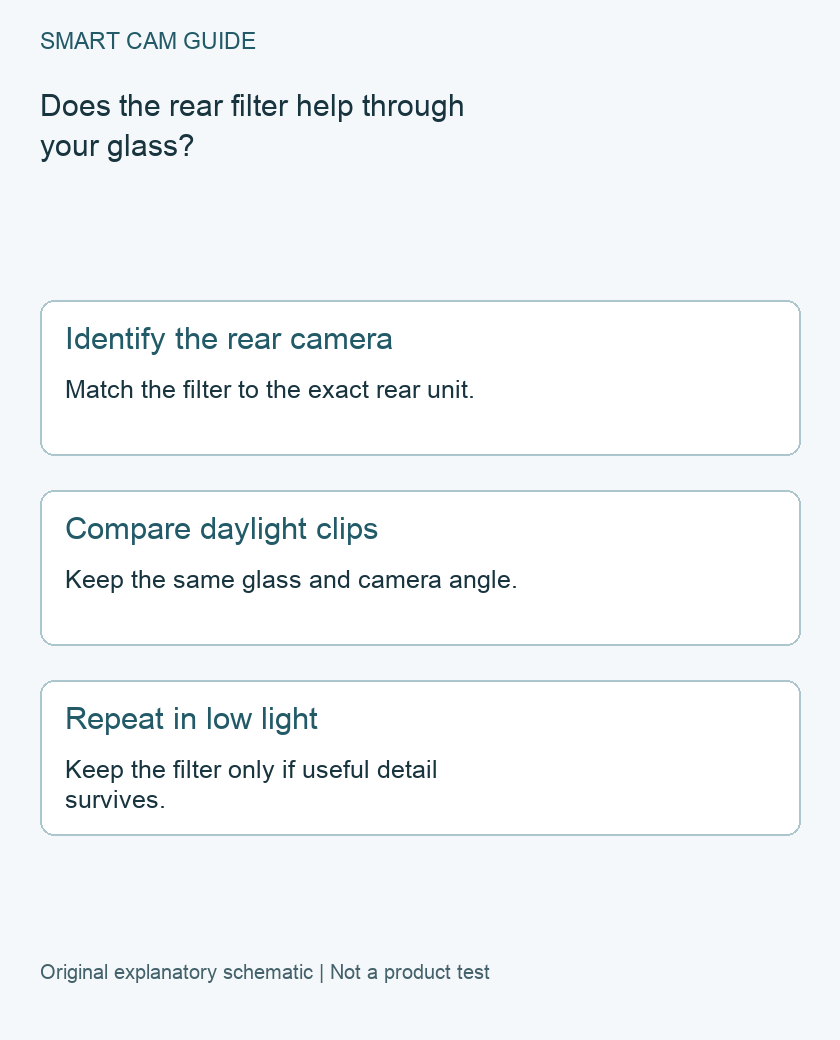
Confirm the rear camera and filter fit
Identify the actual rear camera by its part number and kit documentation. VIOFO lists a CPL-300 rear filter for specified A229-family configurations. Check the exact rear unit against the current compatibility listing before buying. Do not assume a front filter, a waterproof rear camera or another kit’s rear accessory fits merely because the front recorder is an A229 Plus. Follow the accessory instructions and keep the camera and connector supported during installation.
Compare two clips with a useful target
While parked safely, use the same mounting angle, glass, scene and recording settings. Save a rear clip without the filter and one with it under similar daylight conditions. Check whether reflections from cargo trim or cabin objects make it hard to see a vehicle outline or another feature you actually need. Compare the same area at the same playback scale. Easy-to-see reflections elsewhere in the frame may have little bearing on that task.
Repeat with ordinary low lighting. VIOFO notes that its filters can reduce nighttime brightness. Watch for detail that disappears in the shadow area behind the vehicle. Automatic exposure can make two frames look similarly bright while motion detail differs. Compare actual saved footage for the rear channel and keep the observations separate from front footage. Do not adjust a camera or view clips while driving.
Make the keep-or-remove decision
If reflections remain intrusive, first confirm the rear glass is clean inside and outside where accessible. Compare a small approved change in camera position or angle, preserving the field of view and safe cable path. A filter will not fix dirty glass, exposure clipping from lights or an unsuitable mount. If the glare benefit appears only in bright daylight and your key use is night driving, removing the filter may better meet that requirement.
Recheck after normal use. A comparison taken parked in one light condition cannot establish plate readability on a moving vehicle or a guaranteed improvement in all weather. Confirm the rear channel still records and plays after changing any accessory.
Buying option: match the exact product
Compare this filter only for a confirmed compatible standard rear camera such as the RE200. Verify your exact rear head and run both daylight and nighttime comparisons; a polarizer can cost useful light behind tint.
Viofo CPL-300 rear-camera polarizer
Check Viofo CPL-300 rear-camera polarizer details on Amazon
Product link and model mapping reviewed November 16, 2026. Check the selected model, package, seller and current offer before ordering. No live price, stock or delivery is asserted.
Related guides
- Will the VIOFO A229 Plus Rear Cable Reach Your Hatch?
- VIOFO A229 Plus Emergency Lock: Find and Save the Incident Clips
- VIOFO A229 Plus GPS: Speed Stamps, Location Logging and Shared Clips
Sources and research scope
Reviewed November 14, 2026. VIOFO CPL filter family and light tradeoff; VIOFO CPL-300 rear camera compatibility. This is document-based guidance by Smart Cam Guide. The decision worksheet and proposed owner checks are editorial recommendations, not hands-on test results. Exact model, hardware revision and current instructions govern where details differ.