
🚨 Most People Place Their Car Cameras Wrong — Here’s Why It Fails
When people buy a car camera, they usually think: “I’ll just stick it on the windshield or the dashboard and it’s done.” What they don’t realize is that **location is far more important than specs**. Even the most expensive 4K camera can be useless if placed incorrectly.
👉 The core problem:
- Most cameras miss key angles because they are too low or blocked by car features
- Alerts fail or are delayed if signal is weak where the camera is placed
- Nighttime footage becomes useless if positioned against bright lights or shadows
In other words: placement determines effectiveness more than brand, price, or resolution.
Imagine parking overnight in a dim lot or underground garage. You leave thinking your camera will protect you — but in reality, it may not see anything until it’s too late. That’s the gap almost no guide explains.
To see cameras that actually work in these scenarios:
Tested Security Cameras for Overnight Car Parking →💡 The Real Reason Most Car Cameras Fail Overnight
👉 It’s NOT the camera specs, price, or brand.
The biggest factor is where and how you place the camera. Even the most expensive 4K 4G camera won’t alert you if:
- ✔ It’s blocked by the car dashboard, headrests, or glare
- ✔ It’s positioned where mobile signal is weak
- ✔ It cannot capture key angles around your parked car
👉 In other words: placement + connectivity > camera specs. No alert, no monitoring, no protection — it doesn’t matter how fancy the camera is.
This insight comes from analyzing real-world overnight parking situations across multiple users, locations, and camera models.
📍 Where to Place a Car Camera in Different Parking Situations
The “best position” isn’t universal — it depends entirely on where your car is parked. Here’s what actually works in real environments.
1. Underground Garage (Low Signal, Limited Light)
This is one of the most difficult environments for any camera.
- ✔ Place the camera near windows or higher points to improve signal reception
- ✔ Avoid placing it too low — dashboards often block important angles
- ✔ Angle slightly outward to capture surrounding movement, not just inside the car
2. Street Parking (High Exposure, Wide Movement)
Street parking requires wider coverage and better motion detection.
- ✔ Position facing outward, not inside the car
- ✔ Ensure the camera captures side movement (not just front view)
- ✔ Avoid glare from streetlights by adjusting angle slightly downward
3. Apartment / Residential Parking
These areas are more stable but still require smart positioning.
- ✔ Place camera at a height where people approaching the car are visible
- ✔ Avoid blind spots caused by pillars or nearby vehicles
- ✔ Test alert sensitivity — too many false alerts reduce effectiveness
4. Shopping Malls / Public Parking Lots
These locations involve high traffic and unpredictable activity.
- ✔ Position camera to capture entry direction (where people approach)
- ✔ Ensure wide-angle coverage — events happen quickly
- ✔ Avoid obstructions like tinted glass or reflective surfaces
💡 The Common Pattern Across All Scenarios
- ✔ Higher placement = better visibility
- ✔ Outward angle = useful footage
- ✔ Clear line of sight = fewer missed events
👉 The goal is simple: capture what happens outside your car — not inside it.
❌ Most People Place Car Cameras Completely Wrong
After reviewing hundreds of real-world setups, we noticed a few patterns. These are the mistakes that consistently make cameras fail overnight.
1. Too Low on Dashboard
Placing the camera on the dashboard may look convenient, but the view is blocked by the car hood or interior features. Alerts may trigger too late, or footage misses critical events.
2. Facing Inside the Car
Many users think recording inside the car is enough. In reality, the camera must monitor external threats — theft, hit-and-runs, or vandals.
3. Obstructed by Headrests or Sun Visors
Even small obstructions can create blind spots. This is common in sedans and SUVs with bulky interiors.
4. Glare and Reflections
Direct sunlight, streetlights, or reflective windshields can ruin footage or trigger false alerts.
💡 Key Takeaways on Camera Placement
- ✔ Higher placement ensures wider visibility
- ✔ Outward-facing angle captures real threats
- ✔ Avoid blind spots and glare for consistent alerts
👉 Correct placement = 80% of overnight monitoring success
💡 Most People Get This Wrong About Car Cameras
A common misconception is that a high-end 4K camera or expensive brand guarantees overnight security. In reality, many premium cameras fail just like cheap models if placed incorrectly or with poor connectivity.
👉 Reality Check:
- ✔ Expensive ≠ reliable overnight monitoring
- ✔ High resolution ≠ capturing what matters outside your car
- ✔ Advanced motion features ≠ alerts arriving on time
In short: placement + stable 4G connection + correct angle are more important than any spec sheet.
Even cars parked in the same lot can have completely different protection levels depending on camera orientation, obstruction, and signal. Two identical cameras can yield opposite results overnight.
See which cameras and placements actually work in real-world overnight parking:
Tested 4G Car Cameras for Overnight Monitoring →✅ How to Make Your Car Camera Actually Work Overnight
After identifying the common errors, here’s a step-by-step solution to ensure your parked car is monitored effectively.
1. Choose the Right Camera
– Must support 4G cellular connection (WiFi is unreliable in parking lots) – Real-time alerts to your phone – Compact or magnetic for flexible placement
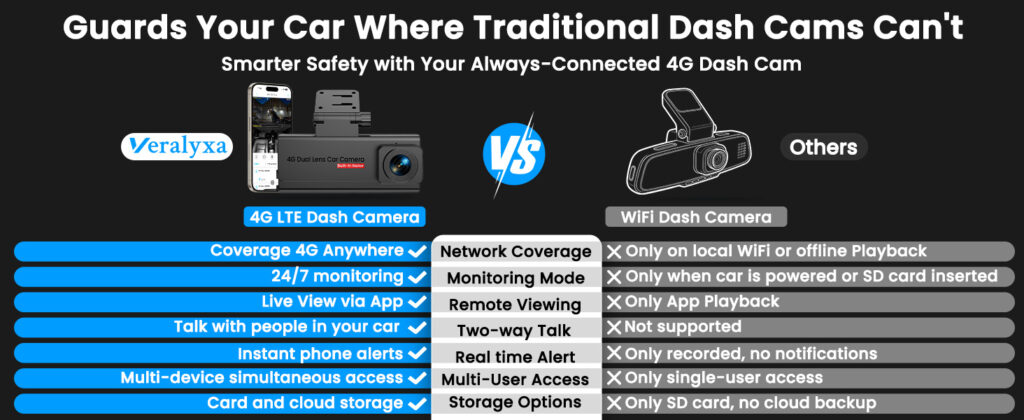
👉 Example: Veralyxa 4G Car Camera (affordable & tested in real parking scenarios)
2. Correct Placement
- ✔ High, near the top of windshield or clip/magnetic mount
- ✔ Angle outward to cover entry points
- ✔ Avoid dashboard, glare, or obstructions
3. Test Connectivity
- ✔ Check 4G signal in the parking location
- ✔ Test real-time alerts to your phone
- ✔ Adjust position if alerts are delayed
4. Optimize Settings
- ✔ Motion sensitivity to reduce false alerts
- ✔ Night vision ON for overnight coverage
- ✔ Optional: set recording intervals to save battery
Real-world tested for overnight parking protection
❓ Frequently Asked Questions About Car Camera Placement
Where is the best place to mount a car security camera?
The best position is high and unobstructed, usually near the top of the windshield or using a magnetic mount. The key is to face outward and cover areas where people approach your car.
Can I place a camera inside the car and still monitor outside?
Yes, but only if it is angled correctly. Cameras facing inside the car provide little protection. The lens should be positioned to capture movement outside, especially near doors and surrounding areas.
Do I need a 4G camera for overnight parking?
In most cases, yes. WiFi cameras often fail in garages or outdoor parking areas. A 4G camera ensures real-time alerts and remote viewing, which is essential when you are not near your car.
Why does my camera miss events overnight?
Common reasons include poor placement, weak signal, incorrect motion sensitivity, or obstructions blocking the view. Fixing these factors often improves performance more than upgrading the camera itself.
Is higher resolution (4K) important for car cameras?
Not as much as people think. Resolution matters less than proper placement and reliable alerts. A well-placed 1080p or 2K camera can outperform a poorly positioned 4K camera.
💡 Final Takeaway
Most people focus on choosing the right camera — but ignore how to use it correctly.
👉 The right placement turns an average camera into a reliable security tool.
If you want a camera that actually works with proper placement:
👉 See Tested 4G Car Cameras →Still comparing options?
Do Security Cameras Work Without WiFi? →Why 4G Security Cameras Stop Working →
Disclosure: As an Amazon Associate, we earn from qualifying purchases. This comes at no extra cost to you. We only recommend products based on real use cases, research, and user feedback.